
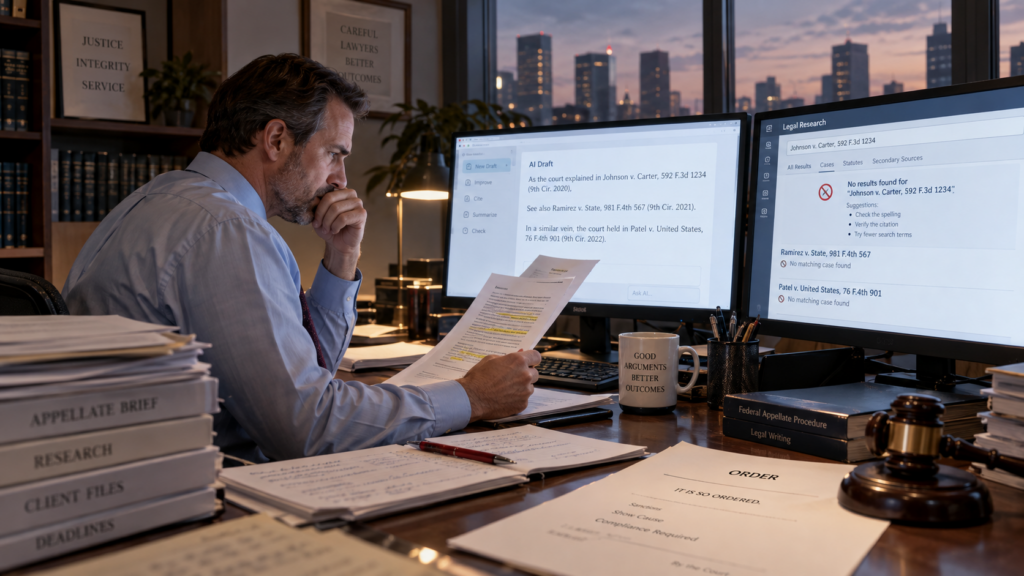
On September 16, Florida’s Fourth District Court of Appeal ordered attorney Jaclyn R. Soroka in Lisandrillo v. Palozzi to show cause why sanctions should not be imposed for frivolous filings that the court suspected contained artificial-intelligence-generated components. The court did not identify fabricated citations or conclusively determine that AI had been used; it focused instead on filings that were scattershot, difficult to understand, and at points contrary to the record or governing law. One week earlier, in Beus Gilbert PLLC v. Brigham Young University, a federal district court in Utah sanctioned two attorneys representing BYU after their briefing included a nonexistent case and multiple authorities that did not support the propositions asserted. The court fined Chad Pehrson two thousand dollars, fined Robert S. Clark one thousand dollars, and ordered Pehrson to complete two courses on the ethical use of AI. On August 27, in the unpublished decision Varma v. Bank of New York Mellon, a California appellate court sanctioned two self-represented litigants in the amount of the respondent’s appellate attorney fees after their brief cited nonexistent cases, false quotations, and unsupported propositions.
These matters are part of a broader pattern. As of September 19, an independently maintained tracker of AI-hallucination decisions had identified more than two thousand decisions worldwide, including nearly fourteen hundred in the United States. The database includes matters involving lawyers and self-represented litigants, and in some entries AI use is inferred or alleged rather than conclusively established. The familiar explanation—that overworked lawyers are cutting corners—is plausible but incomplete. Another possible contributor is automation bias: the tendency to over-rely on automated assistance and therefore miss errors that independent review might have exposed. The reported decisions do not prove that cognitive load or automation bias caused any particular filing error. They do, however, show that knowledge of AI’s limitations has not by itself eliminated verification failures.
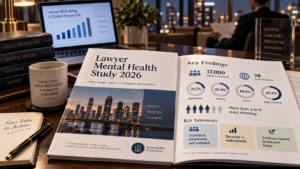
Generative drafting tools have entered legal practice rapidly, while firmwide verification protocols have developed unevenly. The attorney who signs a filing remains responsible for its contents, but responsibility is not exclusively individual. ABA Formal Opinion 512 instructs managerial and supervisory lawyers to establish appropriate policies, training, and oversight for the use of generative AI. Those duties fall on a profession already experiencing substantial strain. A recent ABA and Krill Strategies study found that at least mild symptoms of depression, anxiety, and stress were more prevalent than in the 2016 benchmark. The study also found that 47.4 percent of lawyers screened positive for high burnout—the first comparable national estimate—and that hazardous drinking, although still elevated, was approximately ten percentage points lower than in 2016. Longer total workweeks, particularly 71 or more hours, were associated with sharply higher stress and burnout.
Human-factors researchers have studied related forms of overreliance for decades. Parasuraman and Manzey’s influential review distinguished automation complacency from automation bias but concluded that the two share overlapping attentional mechanisms. Automation bias can produce both omission errors—failing to act because an automated aid did not flag a problem—and commission errors—following incorrect automated advice. Their review also found that the bias can affect novices and experts, individuals and teams, and is not reliably eliminated by training or instructions alone. A later systematic review in the Journal of the American Medical Informatics Association found automation bias in single-task as well as multitask settings, particularly when independently verifying the automated output was cognitively demanding. Its conclusion was narrower than a claim that fatigue inevitably causes error: automation bias appeared associated with cognitive load and was not uniquely associated with multitasking.
For lawyers, the practical implication is to lower the cost of verification rather than rely on resolve alone. Firms can require that every cited authority be opened in an authoritative database, assign a second reader to review citations separately from the general merits, place citation review at defined workflow checkpoints, and document who completed it. These practices are reasonable applications of the cognitive-load literature, although they have not yet been shown in controlled studies to prevent AI-related citation errors in legal practice. Individual clinical work may also have a role. CBT can help a lawyer notice automatic reactions, test assumptions, and practice deliberate pauses; however, using CBT or metacognitive techniques specifically to reduce AI-related citation errors remains a clinical hypothesis, not an empirically established treatment. None of this excuses an attorney who files unverified material. It instead recognizes that individual accountability and sound firm systems reinforce each other.
AttorneyTherapists.com maintains a directory of licensed clinicians and coaches who work with attorneys experiencing practice-related strain.