


In September 2026, the American Bar Association’s Commission on Lawyer Assistance Programs released the most comprehensive update in a decade to its landmark study of lawyer mental health, and the numbers did not move in the direction the profession hoped. Conducted by researchers Patrick Krill and Justin Anker and weighted to the ABA’s 2024 National Lawyer Population Survey, the study titled “When Demands Equal Distress” found that 21.7 percent of attorneys screened positive for clinically significant depression, 20.4 percent for anxiety, and 18.9 percent for stress, figures that sit uncomfortably close to the original 2016 benchmark despite a decade of wellness task forces, well-being committees, and continuing legal education on resilience.
The persistence of these numbers through a period of rapid technological change invites a specific question rather than a general one: has the widespread adoption of generative artificial intelligence, marketed to attorneys as a cure for overwork, instead become a new and measurable source of the distress it was supposed to relieve. The evidence increasingly says yes, and the mechanism is not the technology itself but what the technology demands of the lawyer using it.
The clearest account of that mechanism comes from legal commentator Jason Ward, writing in the ABA Journal, who describes a dynamic he calls Burnout 2.0: artificial intelligence does not eliminate pressure in practice, it recalibrates professional norms so that what once counted as fast becomes expected and what once counted as urgent becomes ordinary.
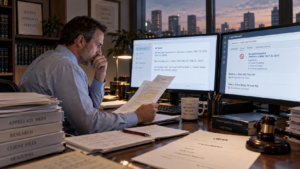
Because a drafting or research task that used to take an afternoon now takes minutes, deadlines compress accordingly, and the time saved rarely returns to the lawyer as rest. In its place comes a new category of labor that Ward terms the verification burden: every citation, quotation, and line of reasoning an AI tool produces must be independently checked before it can be trusted in a filing, a task that keeps the lawyer in a posture of continuous, low-grade suspicion toward a tool they are simultaneously told to rely on. Layered onto this is an isolation effect, as the collaborative habit of asking a colleague down the hall is replaced by a solitary exchange with a chat window, removing a social buffer that research has long linked to resilience against substance misuse and depressive symptoms.
The psychological mechanism underneath the verification burden is well documented outside the legal literature, even if it has rarely been named in it: a checking behavior, performed to resolve uncertainty and reduce anxiety, provides only short-lived relief and reliably strengthens the urge to check again, a pattern clinical psychology recognizes as the maintenance cycle of intolerance of uncertainty found in generalized anxiety and obsessive-compulsive presentations. An attorney who re-verifies an AI-generated citation, then re-verifies the verification, is not practicing diligence so much as running an anxiety loop that AI tools, with their blend of genuine fallibility and superficial confidence, are unusually well suited to trigger and sustain.
Cognitive behavioral therapy offers a direct and tested answer to this exact pattern, because its exposure-based techniques were developed specifically to interrupt reassurance-seeking and checking compulsions rather than to eliminate the underlying uncertainty, which in the case of AI-assisted legal work can never be eliminated entirely. A clinician working with an attorney on this problem would not aim to make the lawyer trust the technology more; the more useful goal is to help the lawyer tolerate not being completely certain, replacing open-ended compulsive re-checking with a single, structured, time-bounded verification protocol decided upon in advance.
For the attorney reading this during a break between tasks, the diagnostic question worth sitting with is not whether AI tools are useful, but whether the checking they require has quietly become a ritual rather than a judgment call, something felt in the body as relief when a citation clears rather than experienced as ordinary professional caution. Firms serious about the problem that Ward and the newest national data both point toward should resist the instinct to compress deadlines merely because drafting got faster, build a defined and bounded verification step into AI-assisted workflows rather than leaving it open-ended, and protect the informal, in-person consultation habits among colleagues that AI chat windows have begun to displace. None of this requires distrusting the technology less; it requires designing the human relationship to it more deliberately than most firms have so far bothered to do. Attorneys who notice the checking loop described here taking hold, or who recognize the broader distress the September 2026 data describe, do not have to work it out alone.