



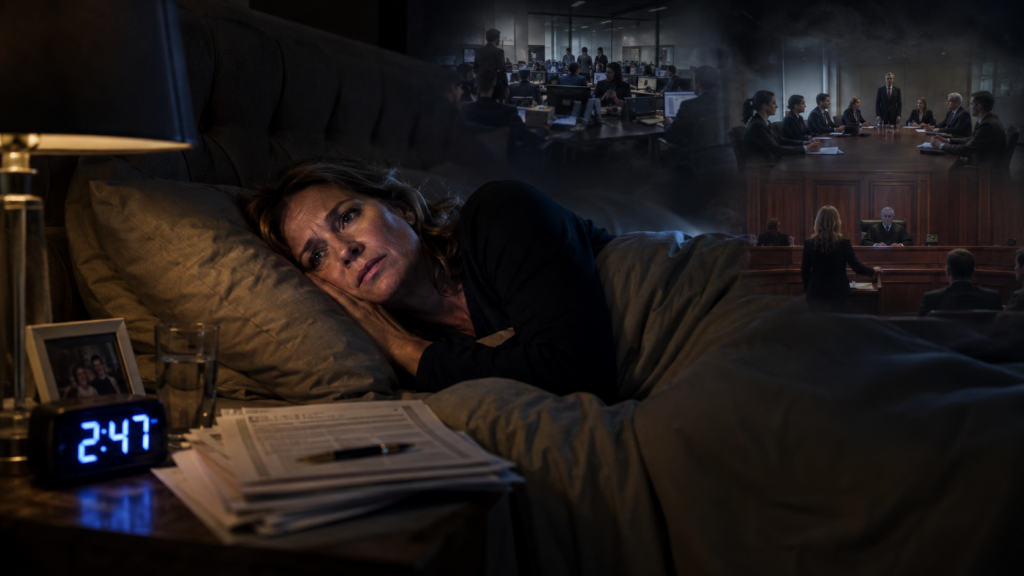
In April 2026, Abdulmajeed Aljasser published Wide Awake: When Lawyers’ Sleep Deprivation Becomes an Ethical Problem on SSRN, arguing that the ABA Model Rules of Professional Conduct — specifically Rule 1.1 on competence, Rule 1.3 on diligence, and Rule 1.16(a)(2) on mandatory withdrawal — already reach chronic sleep deprivation, but only reactively, after professional failure has already occurred. Weeks later, the Minnesota Journal of Law, Science and Technology published Rest My Case: Sleep Science Should Inform J.D. Program Structures and Licensure Examinationsby Laura J. Mott and Paula J. Manning, arguing that the temporal structural norms embedded in legal education and licensure are at odds with established scientific evidence on sleep and circadian biology. Weeks after that, the ALPS Insurance blog published Lawyers: Sleep Is the Key to Staying Mentally Sharp, part of a broader legal-industry conversation identifying lawyers as among the most sleep-deprived professionals in the country.
The scholarship, the industry commentary, and the underlying neuroscience are converging on a picture the profession has spent decades looking past. This article argues that sleep deprivation in lawyers is not a wellness concern. It is a competence problem, an ethics problem, and — most importantly for the reader of this site — a mental-health problem operating through a specific neurobiological mechanism the profession has not been willing to name plainly. The empirical record is unusually clear. The sleep-deprived lawyer is not just at elevated risk of missing a citation. They are being kept in a neurobiological state that predisposes them to anxiety, depression, and impaired emotional regulation, in a profession that has historically encoded that state as professional virtue.
What the sleep-and-cognition record actually shows
The new legal scholarship is drawing on a body of neuroscience that has been unusually consistent for two decades. Several findings recur across the literature and deserve to be stated plainly, because their consequences for legal work are direct.
Sleep restricted to six hours per night for fourteen consecutive nights produces cognitive impairment equivalent to twenty-four hours of total sleep deprivation. The finding, from the foundational Van Dongen and colleagues study, has been replicated repeatedly. What it means, in practical terms, is that a lawyer working sustained six-hour nights across two weeks is performing cognitively as if they had gone an entire day and night without sleep — while in most cases believing themselves to be functioning normally.
Seventeen to nineteen hours of continuous wakefulness produces performance equivalent to a blood-alcohol concentration of 0.05 percent. The comparison is not a rhetorical flourish. It is the actual research finding from the sleep-and-performance literature, comparing sleep-deprived subjects head-to-head with alcohol-impaired subjects on tasks of hand-eye coordination, reaction time, and accuracy. Legal work performed in the last hours of a long day, in a state of accumulated sleep debt, is being performed at a cognitive level the profession would not tolerate if it were being produced by an intoxicated lawyer.
The prefrontal cortex — the region of the brain responsible for the executive functioning that legal work demands, including reasoning, planning, complex problem-solving, and impulse control — is the first brain region degraded by sleep loss. This is not incidental. It is the specific mechanism connecting sleep deprivation to the failures that show up in legal practice. As the North Carolina State Bar’s wellness commentary has noted, while certain parts of our brains can function fairly well on little sleep, the prefrontal cortex, which is the part of our brain that does our lawyering, struggles greatly with sleep deprivation. Attention-intensive performance becomes unstable with increased errors of omission (lapses) and commission (wrong responses). Working memory, the substrate of holding a complex argument in one’s head while evaluating it, degrades measurably. Emotional regulation, discussed further below, begins to slip.
Cognitive performance declines beyond forty-nine to fifty-five work hours per week, with longer hours producing measurably higher error rates in professional tasks. The finding is worth naming because the standard billable-hour targets at many firms sit well past this threshold. The lawyer working seventy or eighty hours a week is not producing more work of equal quality; they are producing more work of measurably degraded quality, and the degradation is happening in the domains most central to their professional value.
The undetectability problem
The single most dangerous feature of sleep deprivation, for legal work and for mental health both, is the fact that it is largely undetectable from the inside. The sleep-deprived person does not feel proportionately impaired. Their subjective sense of alertness recalibrates. They feel functional. They feel capable. They feel confident about the decisions they are making.
The research on this is unambiguous. Subjects in the six-hour-per-night condition of the Van Dongen study, whose cognitive performance had degraded to the equivalent of two nights of total sleep deprivation, were largely unaware of these increasing cognitive deficits. They felt fine. They rated their own alertness as reasonable. They were, on objective measures, cognitively impaired to a degree that would have disqualified them from operating heavy machinery in almost any regulated industry.
For legal work, the implication is significant. A lawyer relying on their own subjective sense of “I feel okay to keep working” is not receiving accurate information. They are receiving the recalibrated subjective report of a sleep-deprived brain assessing its own function using the impaired cognitive apparatus that is producing the impairment. The self-assessment is the wrong instrument. The lawyer who insists they are fine after four hours of sleep and a full day of work is, by the neuroscience, precisely the lawyer whose judgment on the point is least reliable.
The mental-health mechanism the legal conversation has not reached
The legal-industry commentary on sleep, when it exists, tends to focus on cognitive performance and error rates — important, but incomplete. The mental-health dimension operates through a distinct and equally well-documented pathway that deserves to be named directly.
Sleep loss degrades connectivity between the prefrontal cortex and the amygdala, the brain region that mediates threat detection and emotional reactivity. The prefrontal cortex ordinarily exerts top-down regulation on amygdala activity — this is how a thinking, planning, socially embedded person maintains equanimity in the face of provocations that would otherwise produce disproportionate reactions. When sleep loss compromises the connectivity, the amygdala runs unchecked. Threat detection becomes hyperreactive. Emotional reactivity intensifies. Catastrophic thinking, which is normally kept in check by prefrontal reappraisal, becomes more available and harder to modulate.
The practical consequence for a lawyer is direct. The sleep-deprived attorney is more reactive to opposing counsel’s provocations, more likely to catastrophize about a client’s dissatisfaction, more prone to interpret an ambiguous message from a partner as threatening. This is not a personality flaw. It is a well-documented neurobiological consequence of the specific brain-connectivity pattern sleep loss produces. Over years, the pattern becomes chronic. The lawyer who has been sleep-deprived for a decade is not just tired. They have been operating with a functionally different emotional-regulation system for a decade.
The bidirectional relationship between sleep and mental health compounds the problem. The meta-analytic literature has consistently established that insomnia predicts new-onset depression, and depression predicts new-onset insomnia — a self-reinforcing loop that, once established, is difficult to interrupt without direct clinical attention to both sides. Chronic sleep problems are also among the most robust predictors of suicidal ideation in the general population, independent of other mental-health diagnoses. The Krill, Thomas, Kramer, Degeneffe and Anker research on lawyer suicidality identified perceived stress as the strongest predictor of suicidal ideation in their sample of nearly two thousand lawyers. Chronic sleep deprivation both increases objective stress load and amplifies subjective stress perception through the pfc-amygdala mechanism above.
The sleep-deprived lawyer, on this reading, is not incidentally at elevated mental-health risk. They are being maintained in a neurobiological state that produces precisely the conditions the mental-health data is now describing.
The professional responsibility dimension
The novelty of the Aljasser 2026 paper is not the observation that sleep-deprived lawyers perform worse. That has been established for years. The novelty is the argument that the ABA Model Rules already reach chronic sleep deprivation, and that the profession’s failure to address it is a failure of professional responsibility rather than merely of individual wellness.
Aljasser identifies three rules that converge on the issue. Rule 1.1 on competence requires a lawyer to provide competent representation, which includes the legal knowledge, skill, thoroughness, and preparation reasonably necessary for the representation. A lawyer whose prefrontal cortex is chronically degraded to the equivalent of legal intoxication is not, on the neuroscience, providing competent representation, whatever their subjective sense of alertness. Rule 1.3 on diligence requires acting with reasonable diligence and promptness — a standard that presupposes the cognitive capacity to reason clearly about priorities and act on them, capacity that chronic sleep deprivation demonstrably impairs. Rule 1.16(a)(2) on mandatory withdrawal requires a lawyer to withdraw from representation if the lawyer’s physical or mental condition materially impairs the ability to represent the client.
Aljasser’s argument is that the existing framework reaches chronic sleep deprivation only reactively, after professional failure has already occurred — a discipline case, a malpractice claim, a bar complaint. The Minnesota disciplinary case referenced in earlier bar commentary illustrates the pattern: an attorney’s substantial sleep deprivation was considered as a mitigating factor, but only after his indefinite suspension from practice had been triggered by the professional failures the sleep deprivation had produced. This is the reactive model. It arrives after harm. The Aljasser argument, at bottom, is that the rules should be understood to reach the problem prospectively, and that firms and lawyers have professional responsibility obligations to address chronic sleep deprivation before it produces the professional failures the discipline system currently waits for.
Why the profession has resisted taking sleep seriously
The neuroscience has been in place for two decades. The professional-responsibility argument was available before Aljasser drew it explicitly. The profession’s failure to act on either is worth understanding, because it points to what changes when the conversation shifts.
Sleep, in the legal profession, has been culturally encoded as a productivity input rather than a physiological necessity. The lawyer who sleeps less produces more; the lawyer who sleeps more produces less. On that framing, sleep is essentially a choice — trading rest for output — and the professionally serious choice is to trade toward output. The framing is factually wrong on the neuroscience, but it is culturally durable, and it is reinforced by every senior lawyer who quietly signals that sleeping five hours a night is a mark of commitment.
There is also a specific gendered pattern worth naming. Sleep deprivation in the profession has historically been treated as a badge of virility and toughness, with associations to a particular masculine performance of stamina under demand. The Mott and Manning Minnesota law review piece makes the point that these temporal norms are at odds with established scientific evidence, and that women and neurodivergent lawyers often absorb disproportionate cost from norms designed around a fictional baseline. The badge is expensive. The people paying for it are not always the people wearing it.
Finally, the profession has resisted the sleep conversation because taking it seriously would require structural changes — to billable-hour targets, to client-service expectations, to the norm of after-hours availability, to the design of legal education itself — that no individual firm can make unilaterally without competitive cost. The result is a coordination problem: everyone knows the norms are damaging, and no one can afford to be the first to break them. This is the exact structure of a problem that requires bar-level and firm-level institutional response, not individual wellness interventions.
What individual lawyers can actually do
The individual response to structural conditions is limited, but it is not zero. Several things are worth naming clearly, distinguished from the standard sleep-hygiene tips that fill wellness content on this topic.
First, take the neuroscience at its word. If you are averaging six hours or less across weeks, you are not “getting by.” You are cognitively impaired in ways your subjective self-assessment cannot detect. The professional and personal costs are accruing, whether or not you can feel them yet. The recalibrated subjective report of the sleep-deprived brain is the least reliable evidence on this question.
Second, understand that sleep debt is not fully recovered by weekend catch-up. The pattern of sustained restriction followed by weekend recovery does not restore prefrontal function to baseline. It temporarily reduces the symptoms while the underlying pattern continues. Consistent sleep across seven days is the only pattern the research supports.
Third, if you are experiencing anxiety, depression, or emotional dysregulation that has developed alongside chronic sleep deprivation, treat the sleep and the mental-health symptoms as connected rather than separate. The bidirectional pathway means treating one without the other typically fails. Clinicians who understand the sleep-mental-health interaction, including those with training in Cognitive Behavioral Therapy for Insomnia (CBT-I), have effective evidence-based tools for interrupting the loop. Sleep problems that have persisted for months are not going to resolve through willpower or sleep hygiene alone.
Fourth, notice the professional-responsibility dimension of your own situation. If you are practicing in a state of chronic cognitive impairment that is producing errors, missed details, or reactive interactions with clients and colleagues, the Aljasser reading of Rules 1.1, 1.3, and 1.16 is not a distant academic concern. It is your practice reality. The competent response is not to keep pushing through; it is to address the underlying condition.
Reframing what the sleep conversation is actually about
The legal profession’s sleep conversation has been trapped, for years, at the level of individual advice — tips for better rest, encouragements to unplug, reminders to prioritize wellness. The new scholarship is reframing the conversation at the correct level: sleep is not a personal virtue to be cultivated, it is a physiological requirement for competent legal practice, and chronic sleep deprivation is a professional responsibility problem, a mental-health problem, and — increasingly — an ethical problem the profession will not be able to ignore much longer. The reframing is overdue.
Lawyers who recognize the pattern this article describes in their own lives — the persistent sleep restriction, the recalibrated sense of “I feel fine,” the emotional reactivity that has crept into professional interactions, the anxiety or depression symptoms that have developed alongside years of insufficient rest — would do well to bring those signals to a clinician who understands both the sleep neuroscience and the specific structural conditions of legal work that produce it. AttorneyTherapists.com maintains a directory of licensed clinicians who specialize in working with attorneys, including practitioners with training in CBT-I and in the sleep-mental-health interaction more broadly.