



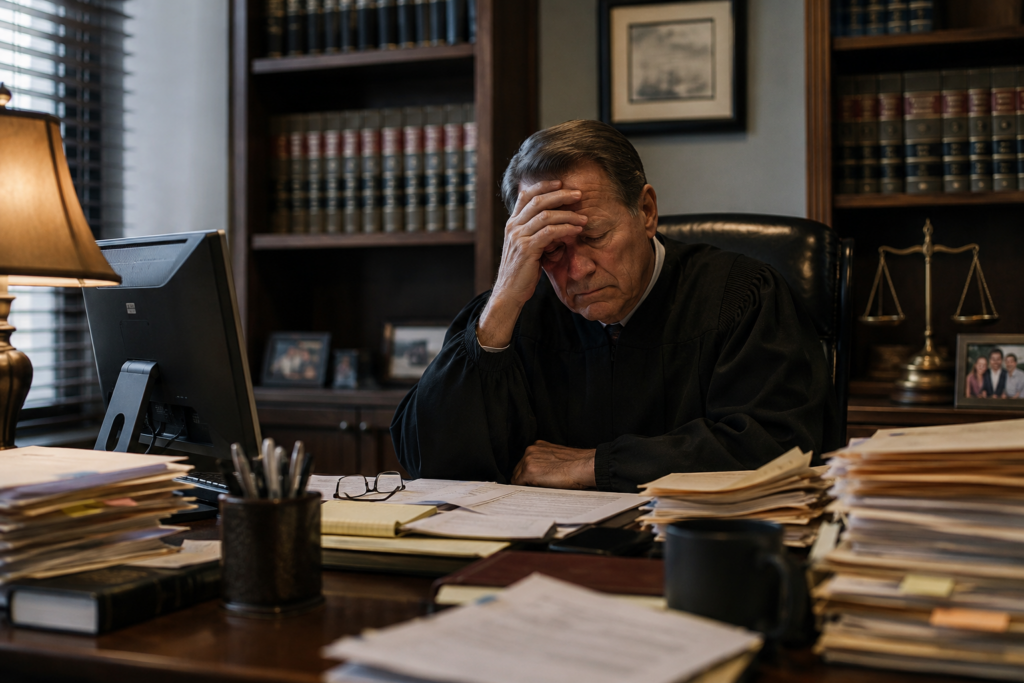
On June 11, 2026, the American Bar Association’s Commission on Lawyer Assistance Programs published Chase Andersen’s “Beyond Burnout: Building Healthier Legal Workplaces” through its Judicial Resource Committee. The piece appeared at a moment when the legal-wellness conversation, after a decade of accelerating attention, has built considerable infrastructure around the mental health of practicing attorneys and law students. The infrastructure around the mental health of judges remains thin, scattered across handful of state-level wellness committees, and dwarfed by the resources directed at the bar generally. The January 2026 issue of Judicature, Duke Law’s judicial journal, devoted an extended article to Judicial Well-Being and Mindfulness, opening with a 2021 survey of nearly eight thousand Canadian legal professionals in which 24.4 percent reported suicidal ideation — and observing, with notable understatement, that despite the steady accumulation of such data, the well-being of judges has not received the attention afforded to lawyers and law students.
This article argues that judicial mental health is the lawyer-wellness conversation’s largest unaddressed area, and that the omission is not accidental. Judges are exposed to a cluster of stressors that the practicing-attorney framework was not designed to recognize, and they face structural barriers to seeking help that practicing attorneys do not face. The clinical frameworks that would clarify what is happening — moral injury and secondary traumatic stress — are well-established in the military, healthcare, and trauma-therapy literatures, but they have not meaningfully entered the bar-association conversation about judicial wellness. The result is a population at elevated risk for depression, anxiety, and burnout that is, by structural design, harder to reach than perhaps any other group within the legal profession. Naming the clinical picture properly is the first step toward closing the gap.
What we know about judicial stress and mental health
The empirical record on judicial stress, though smaller than the record on practicing-attorney stress, is consistent and concerning. An August 2025 peer-reviewed Judicature study testing the Miller-Richardson Model of Judicial Stress found that judicial stress significantly predicted judges’ self-reported mental health, job satisfaction, perceptions of safety and security, and certain job-efficacy measures. The model’s authors have, over the better part of two decades, accumulated evidence that the stressors of judicial work — heavy caseloads, exposure to distressing material, isolation, the weight of consequential decision-making, hostile media attention, and now in many jurisdictions explicit threats against judges and their families — produce measurable psychological harm.
International evidence is similar. The Boston Bar Association’s Judicial Wellness survey of Massachusetts judges found that respondents reported difficulty maintaining work-life balance, struggle with the visibility of public criticism, and a consistent inability to step away from work effectively. The United Nations Office on Drugs and Crime, citing an Australian survey of judges and magistrates, reported that the judiciary as a population was at elevated risk of burnout and trauma, with significantly high levels of psychological distress.
The figures place judges in a population whose mental-health profile sits at least adjacent to, and on some measures may exceed, the practicing-bar profile that the legal-wellness literature has spent the last decade documenting. The reasons judicial mental health rarely surfaces as a discrete topic in the wellness conversation are themselves part of the clinical picture.
The structural barriers to judicial help-seeking
Judges face a set of structural barriers to mental-health care that practicing attorneys do not face, or do not face to the same degree. The barriers are not principally about access to clinicians or insurance coverage. They concern visibility, ethical constraint, and the role-specific stigma that attaches to judicial vulnerability.
The first barrier is the visibility problem. A practicing attorney who attends a recovery meeting, a therapy appointment, or a wellness program does so as a private individual. A sitting judge who does the same is potentially recognizable, potentially photographed, potentially identifiable through court documents, and potentially the subject of inferences about their fitness for the bench. The American Bar Association’s Resources for Judges page has been thoughtful about offering judge-specific peer support programs, judges-helping-judges hotlines, and confidential channels — precisely because the general public-facing infrastructure does not, for this population, provide the privacy other professionals can assume.
The second barrier is the ethical-constraint problem. Judges operate under codes of judicial conduct that limit their participation in public commentary, their disclosure of personal information, their political activity, and their relationships with attorneys who might appear before them. The same codes that protect the integrity of the bench also constrain the candid public engagement that lawyer-wellness initiatives have used effectively to reduce stigma. A judge cannot easily write a public essay about their own depression, addiction, or trauma. The professional accountability for such candor falls more heavily on judges than on practitioners, and many judges therefore do not undertake it.
The third barrier is role-specific stigma. The bar’s stigma against mental health treatment, well documented in surveys of practicing attorneys, is amplified for judges by the fact that judicial fitness is itself the subject of formal and informal review. A judge whose mental health treatment becomes known to opposing counsel, to the press, or to a recusal-motion drafter does not face the same private inference that a practicing attorney faces. The judge faces a potential professional crisis. The 2025 Judicature study cited earlier found that judicial stress significantly predicted judges’ perceptions of safety and security — and “safety” in that context includes the perceived safety of disclosing struggle to anyone in a position to act on it.
These barriers are not abstractions. They are the lived conditions under which judges decide whether to seek help. They are also why the surface-level interventions that have moved the needle for lawyers — public wellness campaigns, openly attended meetings, normalized therapy-going — translate poorly to the judicial context. The barriers are structural, and the response needs to be structural too.
Moral injury as a clinical frame for judicial work
Two clinical frameworks, both well-established in adjacent professional literatures, have direct applicability to judicial work and have not yet been meaningfully applied to it in the legal-wellness conversation. The first is moral injury.
The concept of moral injury, as developed by Brett Litz and colleagues in their foundational 2009 paper in Clinical Psychology Review, describes the psychological wound that follows from “perpetrating, failing to prevent, bearing witness to, or learning about acts that transgress deeply held moral beliefs and expectations.” The framework was developed initially for military veterans who had performed acts under orders that produced deep ongoing psychological cost, even when those acts were legally and operationally necessary. The framework has since been extended to healthcare workers who must allocate scarce resources during crises, child protective services workers who must remove children from homes they know contain trauma in either direction, and trauma therapists who must repeatedly enter material no one else will share. The literature on moral injury consistently associates the construct with depression, post-traumatic stress, substance use, and suicide ideation.
Apply the frame to judicial work. A judge in a criminal sentencing posture must repeatedly impose sentences that the judge knows will produce devastating consequences — for defendants, for families, for communities — even when the sentences are legally required, proportionate, and correct on the law. A family court judge must repeatedly award custody arrangements that will reshape children’s lives along lines the parents disagree with and the judge cannot perfectly know are right. A mental health hearing officer must repeatedly determine that the conditions for involuntary commitment have or have not been met, knowing that the wrong determination either way produces serious harm. An immigration judge must repeatedly enter removal orders that will separate families and return individuals to circumstances the judge has no power to alter. These are not failures of judging. They are the everyday work of judging done correctly. The moral weight is intrinsic to the role.
The moral-injury framework names a clinical reality that the standard burnout frame cannot quite reach. Burnout describes exhaustion, depersonalization, and reduced sense of efficacy. Moral injury describes something more specific: the cumulative cost of repeatedly performing acts that, even when correct, transgress the judge’s own sense of what they would do if they could choose freely. Years and decades of that cumulative cost produce a clinical picture that ordinary stress-and-burnout interventions do not address, because the underlying mechanism is not exhaustion but a wound to the moral self.
Secondary traumatic stress and the cumulative cost of exposure
The second clinical framework with direct judicial application is secondary traumatic stress. The construct, well-developed in the literatures on first responders, child welfare workers, and trauma-focused clinicians, describes the psychological cost of repeated exposure to others’ traumatic material — even when the worker is not the direct victim. Secondary traumatic stress shares features with post-traumatic stress disorder: intrusion symptoms, avoidance, negative changes in cognition and mood, and altered arousal. Workers exposed to traumatic content for sustained periods, without adequate support and processing, predictably show measurable psychological harm.
Judicial work involves exposure to traumatic material at volumes that would be considered clinically significant in any other professional context. A criminal court judge reads and hears, week after week and year after year, accounts of homicide, sexual assault, child abuse, domestic violence, and human suffering of every variety. A family court judge encounters the documented histories of children who have been removed, parents in active addiction, witnesses to violence, and the slow attrition of family systems under strain. Personal injury and product liability judges encounter the medical records of the catastrophically injured. Even commercial litigation judges, whose dockets are nominally about contracts and money, encounter the underlying human catastrophes — businesses destroyed, lives upended, retirements lost — that the legal disputes encode.
The judge’s role requires the maintenance of equanimity in the face of this material. The very professionalism that makes judicial work possible — the controlled affect, the measured response, the refusal to be visibly moved — also creates the conditions under which secondary traumatic stress is most likely to accumulate without recognition. The judge processes the material, makes the ruling, and turns to the next case. The cumulative load is rarely acknowledged, and the social-permission to acknowledge it is itself limited by the judicial role.
The Boston Bar Association’s judicial wellness work has, helpfully, begun to identify exposure to distressing material as a discrete dimension of judicial stress. The clinical literature is now well-developed enough to support a more specific intervention than the standard wellness-program approach. Secondary traumatic stress responds well to consultation, peer-support structures, and trauma-informed individual therapy. None of these requires the judge to publicly disclose anything. All of them require institutional acknowledgement that the exposure is real and that the cost is professional, not personal.
The unique loneliness of decision-making no one can share
A third feature of judicial work, distinct from but related to the first two, is the structural loneliness of judicial decision-making. The judge makes decisions that no one else, in the moment, can share. Co-judges sit on the same bench but rule their own dockets. Family members cannot be told the substance of pending matters. Friends in the bar cannot be approached as colleagues without raising recusal and propriety concerns. The judge processes the weight of each decision largely alone.
The Krill, Thomas, Kramer, Degeneffe and Anker research on lawyer suicidality identified loneliness — measured as the subjective felt sense of being unseen and unjoined, not objective social isolation — as the second-strongest predictor of suicidal ideation in their sample, behind only perceived stress. Judges, by the structure of their role, are exposed to a particularly distilled version of this dimension. They are surrounded by people, often visibly and publicly, while doing work whose internal weight is, in any granular sense, unsharable.
The cumulative interaction of structural loneliness, moral injury, and secondary traumatic stress is, in my professional view, the clinical picture the existing wellness literature has not yet drawn. Each component on its own is well-documented. The combination, applied to the judicial role, names a population at elevated and largely unaddressed mental-health risk.
What needs to change, and what individual judges can do today
Institutional change is the larger frame, and it is where the bar’s reform energy is most needed. Judicial wellness committees in every state, properly resourced and properly confidential. Peer-support programs that respect the visibility constraints of judicial office. Continuing legal education that introduces moral injury and secondary traumatic stress as named clinical concerns rather than as euphemisms folded into “burnout.” Court-system policies that recognize trauma-informed practice as applicable to judges as well as to litigants. None of this is fast. All of it is overdue.
For individual judges, several practical steps follow. First, recognize that the cumulative weight of judicial work has named clinical correlates, and that recognition is itself a clinical act with measurable psychological value. The unnamed weight is harder to address than the named one. Second, treat the visibility problem as a clinical-design constraint rather than as a reason for inaction. Confidential therapy with a clinician who understands the unique constraints of judicial office is broadly available, even where state-level judicial wellness infrastructure is thin. Third, peer connection with other judges, structured around the professional realities of the role, is one of the few interventions that addresses structural loneliness without requiring the disclosure the role does not permit. Judges-helping-judges programs exist in most jurisdictions and are typically expressly confidential. Fourth, take seriously the difference between exhaustion and moral injury. The standard wellness recommendations — sleep, exercise, time off — are necessary but not sufficient. A judge who has been carrying years of accumulated moral weight will not be repaired by a vacation, however necessary the vacation is. The deeper work requires the involvement of a clinician familiar with the framework.
Closing the largest blind spot
The lawyer-wellness conversation has built useful infrastructure for practicing attorneys and law students. The infrastructure for judges remains the conversation’s largest blind spot, and the empirical and clinical literatures are now well-developed enough to support a meaningful expansion. Naming the problem properly — moral injury, secondary traumatic stress, structural loneliness, the unique help-seeking barriers of judicial office — is the precondition for institutional change. It is also, for individual judges, the precondition for the personal recognition that often precedes the decision to seek help.
Judges who recognize the patterns this article describes in their own professional lives — the cumulative weight of consequential rulings, the unprocessed exposure to traumatic material across years of dockets, the felt impossibility of letting anyone in their working life see the actual cost of the job — would do well to bring those signals to a clinician who understands both the judicial role and the clinical frameworks that fit it. AttorneyTherapists.com maintains a directory of licensed clinicians who specialize in working with attorneys and judges, including clinicians who work with moral injury, secondary traumatic stress, and the role-specific configurations of stress that judicial office produces. The directory exists in part to make confidential first contact possible for a population the broader mental-health system has not been built to serve well.